Telemedicine Society of India Gujarat Chapter
TSI GUJCON'26
Saving Lives Through Tele-Medicine
22 March 2026, Sunday
Atal-Kalam Bhavan, GUSEC
Program
Scientific Flow
01
Panel Discussion
Challenges to Implement Telemedicine Practice in India
Moderator: Dr Vivek Dave
- Mr Virender Kumar
- Dr Krishna Kumar
- Dr Raj Rawal
- Dr Chinmay Shah
- Dr Dipika Dash
02
Current Scenario
ABHA Implementation as Digital Health Mission
Dr Bhruguraj Trivedi
03
Digital Health
Law, Ethics and Responsible Innovation
Dr Sunil Shroff
04
Data Privacy and Cyber Security
Mr Dharmesh Dave
Path to the Future
05
ISRO and Telemedicine
Past, Present and Future
Mr. Virender Kumar / Mr. Sudhir Agrawal / Mr. Arvind Tyagi
06
Telemedicine Practice Guidelines
Dr Krishna Kumar
07
AI in Telemedicine
Dr Raj Rawal
08
Tele-Robotics
Dr Sanjeev Haribhakti
Mobile and Wearable Devices
09
Mobile Applications in Healthcare
Mr Taral Shah
10
Respicoz: Continuous Capnography
Mr Kunal Prajapati
Startups Corner
GUSEC: A World of Startups / Healthcare Startups
Mr Bishwajit Adhikari
Video
Watch the Conference
Highlights
Session Summaries
Inaugural Session: Strategic Vision and History
- ISRO's Role: Dr. Nilesh Desai (Director, SAC-ISRO) highlighted ISRO's 25-year legacy in telemedicine, including a recent MOU with Integrated Defense Services. He introduced future technologies like "Satcom on the Move" (mobile telemedicine nodes) and Quantum Key Distribution (QKD) to secure medical and financial data.
- Digital Health Vision: Dr. Sunil Shroff (President, TSI) emphasized that technology is now a primary care driver, moving toward precision medicine while cautioning that the "human touch" must remain central.
- Ecosystem Growth: Dr. Shrinivas Rao (CEO, GUSEC) discussed the "telemedicine revolution" and GUSEC's role in incubating med-tech startups to reach inaccessible regions.
Session 1: Implementation Challenges in India
Panel Discussion: Moderated by Dr. Vivek Dave, the panel addressed infrastructure and digital literacy gaps in rural India.
- The Telemedicine Practice Guidelines (TPG) 2020 provided the essential legal framework that protected both patients and doctors during the pandemic.
Session 2: Ayushman Bharat Digital Mission (ABDM)
- Building Blocks: Dr. Vatsrajani detailed the implementation of the ABHA (Ayushman Bharat Health Account), which allows for consent-based, paperless health record sharing.
- Professional Registries: The session urged all doctors to register on the Healthcare Professional Registry (HPR) and Health Facility Registry (HFR) to integrate into the national digital backbone.
- Incentives: The government is offering digital health incentive schemes (DHIS) to hospitals to encourage the linkage of digital health records.
Session 3: Digital Health Law, Ethics, and Responsible Innovation
- TPG Compliance: Dr. Sunil Shroff provided a deep dive into the TPG 2020, clarifying that telemedicine is an enabler, not a replacement, for traditional care.
- Record Preservation: Records must be kept for 3 years (10 years for medico-legal cases).
- Shadow AI: A critical warning was issued regarding "Shadow AI"the unauthorized use of public AI tools (like ChatGPT) with sensitive patient data, which can lead to severe privacy breaches and massive legal fines under the DPDP Act.
Session 4: Data Privacy and Cyber Security
- Threat Landscape: Mr. Dhaval Davesar highlighted the CIA Triad (Confidentiality, Integrity, Availability) and the rising threat of ransomware in healthcare, citing the KD Hospital attack as a case study.
- Security Protocols: The session covered vulnerabilities in IoT medical devices (e.g., infusion pumps) and recommended regular security audits and avoiding public Wi-Fi for clinical work.
Session 5: Deep Dive into Tele-Medicine Practice Guidelines
- Regulatory Framework: Dr. Krishna Kumar clarified that TPG remains legally valid under the NMC Act 2019.
- Consultation Categories: Detailed the requirements for "First Consult" versus "Follow-up Consult" and the strict categorization of drugs (Lists O, A, B, and Prohibited) that can be prescribed remotely.
Session 6: Tele-Robotics and Future Surgery
- Milestone Achievement: Dr. Sanjiv Haribhakti presented the first tele-robotic surgery in Gujarat, performed on a patient in Ahmedabad while he was in Delhi.
- SSI Mantra: The use of the indigenous SSI Mantra robot, which is CDSCO-approved for tele-surgery, was highlighted as India leading the world in this field.
- Technical Needs: Successful tele-surgery requires a latency of less than 200 milliseconds to ensure the surgeon does not feel a lag.
Session 7: ISRO's Continuing Medical Education (CME)
- Educational Outreach: ISRO has conducted 109 CME sessions since 2012, reaching over 20,000 healthcare professionals, particularly those in remote defense outposts like the Siachen Glacier.
- Space Medicine: Future ISRO projects will focus on Space Medicine, researching how microgravity affects molecule binding for new drugs and crop cultivation for long-term space missions.
Session 8: Startups and Mobile Innovations
Patient-Centric Shifts: The move from "hospital-centric" to "mobile-first" care was discussed, with mobile apps acting as the fulcrum for real-time monitoring.
- RespiGO: A portable capnography device for real-time CO2 monitoring.
- Locomotion: A wearable sensor for clinical gate analysis.
- D3S Healthcare: The "VR Skin Scan Light," a portable red-light technology for early-stage breast cancer screening.
Photos
Gallery
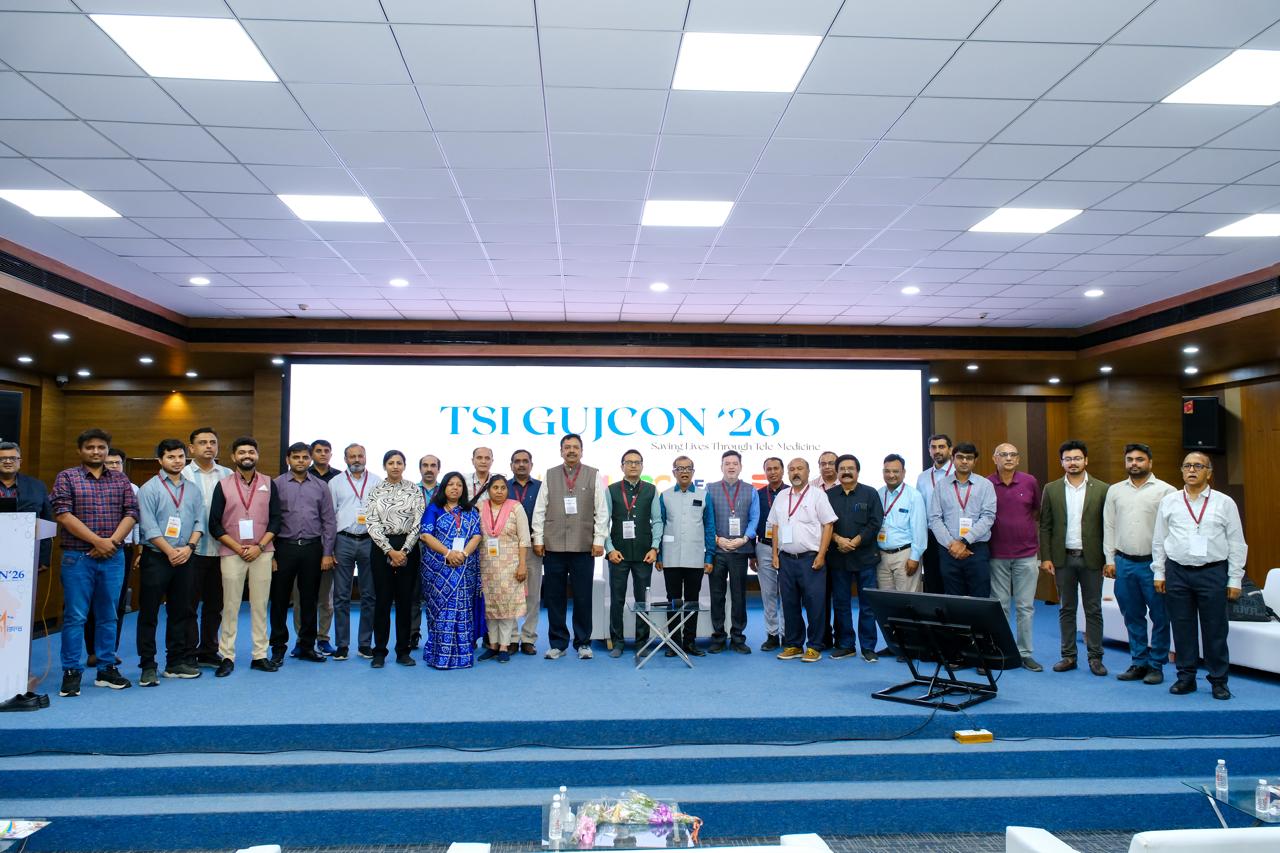
At the National Anthem
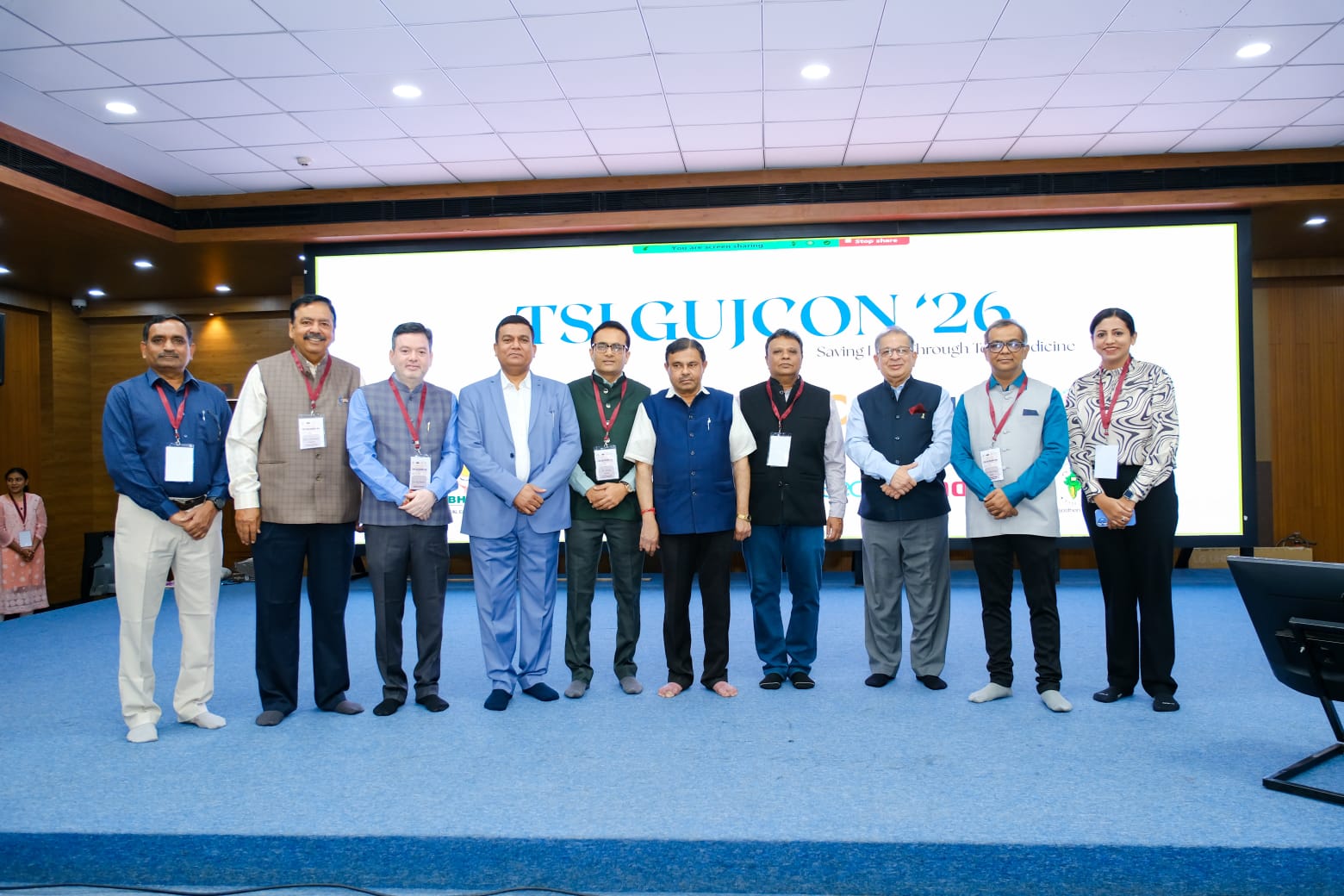
Dignitaries of TSI GUJCON'26
Press
Media Coverage
Pre-conference coverage Divya Bhaskar
Post-conference coverage Divya Bhaskar
Team
TSI Gujarat Chapter Office Bearers
RR
Dr. Raj Rawal
President
VK
Mr. Virender Kumar
Vice President
CS
Dr Chinmay Shah
Secretary
VD
Dr Vivek Dave
Treasurer
Tip: Use mouse wheel / trackpad to zoom.